How much baseboard or trim do you need?
Measure the perimeter, not the floor area
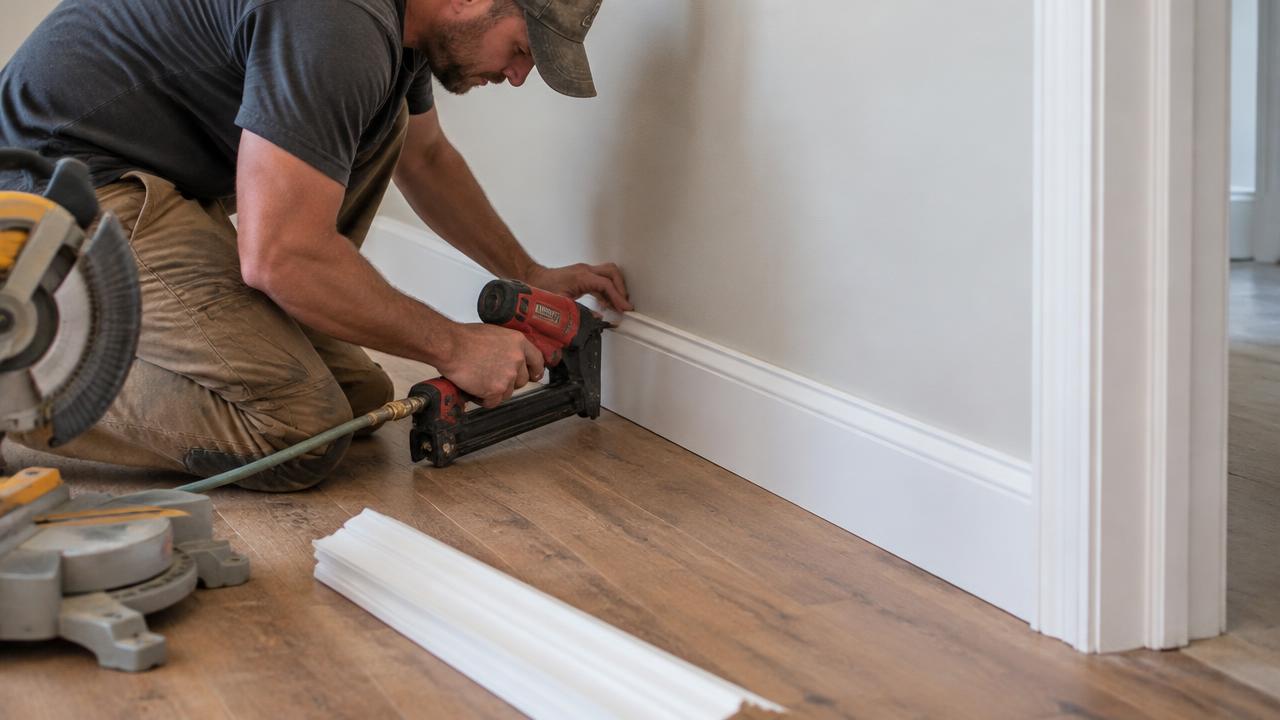
Baseboard and trim are bought by length, so the starting point is the perimeter of the room in linear feet or metres, not the floor area in square feet or square metres. This calculator adds up the room's dimensions to find the total perimeter, which is the length of baseboard you would need if every wall were solid from corner to corner with no interruptions.
From there, the calculation adjusts for the parts of the perimeter that will not get baseboard at all, since doorways and similar openings break up an otherwise continuous run of trim.
Subtracting doors and openings
Every doorway interrupts the baseboard run along that wall, so its width should be subtracted from the total perimeter before you calculate how much material to buy. Wide openings such as archways, closets without doors, and openings into hallways should also be subtracted. Forgetting this step is the most common reason people over-order trim, sometimes by a noticeable margin in a room with several doors.
This calculator asks for the number and typical width of doors in the room so it can make this subtraction automatically, giving you a more realistic linear footage figure to work from.
Buying in standard lengths
Trim is sold in fixed lengths, commonly 8, 12 or 16 feet in the US, or 2.4 metres as a common length elsewhere, and you cannot buy a fraction of a board. The calculator converts your net linear footage into a number of boards at your selected standard length, rounding up so you always have enough. Longer boards reduce the number of seams in a run, which generally looks better and takes less filling and sanding, but they can be harder to transport and maneuver in a smaller vehicle or room.
Add a waste allowance of around 10 percent to account for cutting mitres at corners, trimming for a tight fit, and the occasional mis-cut, especially in rooms with many corners or angled walls.
Costing the full trim package
Baseboard is often bought alongside matching door and window casing, so once you know your linear footage, use our renovation budget calculator to add paint or stain, corner blocks or mitred corners, caulk, and finishing nails to get a complete cost for the trim package rather than just the boards themselves. If your lumber yard has quoted you a price per linear foot or metre, enter it under "Custom amount" for a more accurate total.
Exact lengths and waste allowances depend on room shape and your chosen corner technique, so a finish carpenter can confirm quantities precisely before you place a large trim order.
How it's calculated
Perimeter = 2 × (length + width), minus about 3 ft (0.9 m) for each doorway. We add your waste allowance for mitre cuts and divide by the board length you plan to buy, rounding up.
Worked example
A 14 × 12 ft room with one door: 2 × 26 = 52 ft − 3 = 49 ft, +10% = 53.9 ft → 4 boards of 16 ft, about $108 in pine.
Frequently asked questions
+How much extra baseboard should I buy?
10% covers mitre cuts and mistakes in a normal room. Use 15% for rooms with many corners or bump-outs.
+Are longer boards better?
Yes, they mean fewer joints along long walls. Make sure you can transport them home, though.
+Can I use this for crown moulding?
Yes for a rough figure: set doorways to 0 because crown runs over doors. Crown corners waste more, so use 15%.
+Should I cope or mitre inside corners?
Coping inside corners gives tighter joints that stay closed as the house moves. Mitre outside corners.
+Can I enter my own price?
Yes. Choose "Custom amount" and enter the price per foot or metre.