How much concrete do you need for a slab or footing?
Volume, not area, is what you are buying
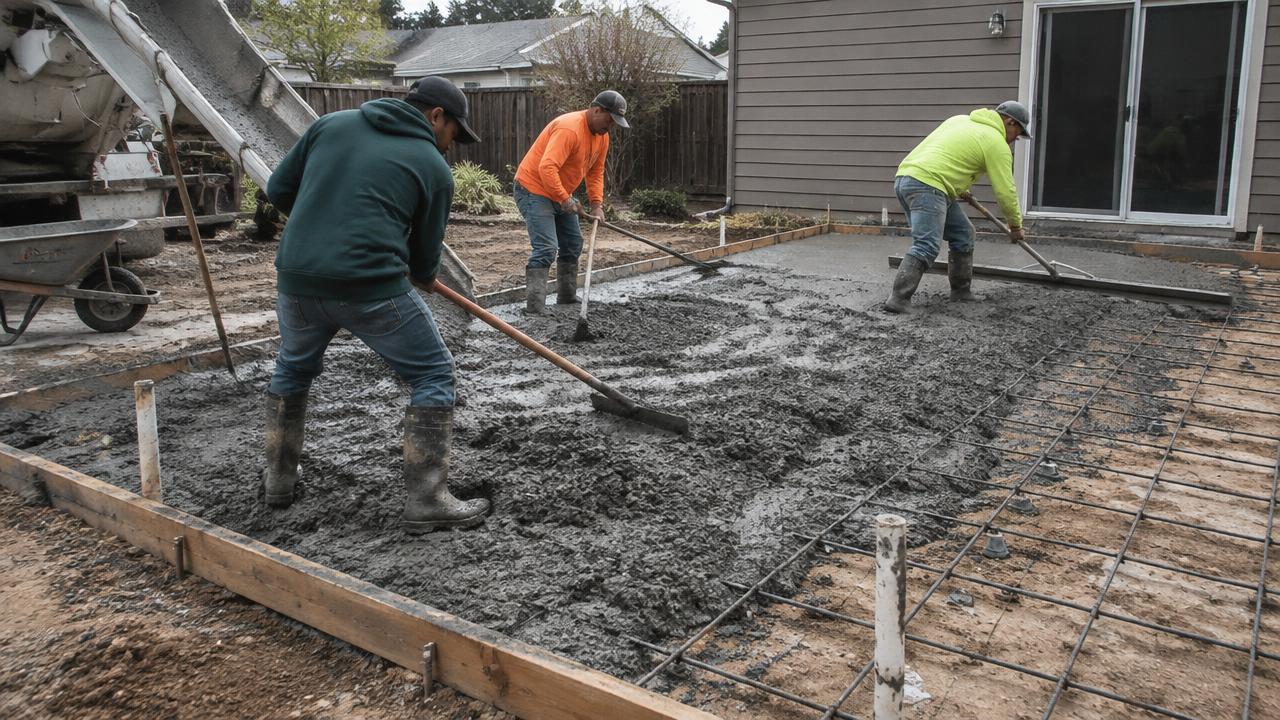
Concrete is sold and poured by volume, so the question "how much concrete do you need" always comes back to length times width times thickness. A patio slab 10 feet by 12 feet at 4 inches thick needs a different volume than the same footprint at 6 inches, even though the footprint looks identical on a plan. Footings are even easier to get wrong because their width and depth are often hidden below grade and easy to underestimate when you are working from a rough sketch rather than a stamped drawing.
This calculator converts your dimensions into cubic yards for imperial users and cubic metres for metric users, so you can compare quotes on the same basis a ready-mix supplier uses. Enter length, width and thickness in whichever unit you are comfortable with, and switch units at any time without losing your numbers.
Bagged mix or ready-mix truck
Small jobs such as fence post footings, a shed pad or a short section of path are usually cheaper and easier with bagged concrete mixed on site, typically sold in 60 or 80 pound bags in the US or 20 and 25 kilogram bags elsewhere. Anything over about one cubic yard or one cubic metre usually tips the balance toward a ready-mix truck, because mixing that much by hand is slow and the quality is harder to control pour to pour.
The calculator shows both the raw volume and an estimated number of bags, so you can decide which route suits the size of your project. If your local supplier prices concrete differently, for example by the load rather than the cubic yard, switch the price field to "Custom amount" and enter the rate you have been quoted.
Always add a waste allowance
Ground is rarely perfectly flat and formwork is rarely perfectly square, so professional estimators add a waste and spillage allowance of around 10 percent to the calculated volume. This covers uneven excavation, minor form movement during the pour, and the concrete that inevitably ends up on the wheelbarrow and the ground rather than inside the forms. Ordering exactly the theoretical volume is the most common reason a ready-mix order falls just short, forcing an expensive small top-up load.
For footings in particular, check your local building code for the required depth below frost line or the bearing depth specified by your engineer, since this figure has a much bigger effect on volume than most people expect.
Planning the rest of the project
Concrete is only one line in a larger job. If the slab is part of a patio, deck or driveway project, our renovation budget calculator can help you track the concrete cost alongside excavation, forming, reinforcement, finishing and any sealer or decorative treatment you plan to add. Keep a receipt of your volume calculation so you can compare it against what the supplier actually delivers.
Mix design, reinforcement and curing times all affect strength and should be confirmed with a structural engineer or experienced contractor for anything load-bearing, such as a foundation footing or a slab carrying a heavy structure.
How it's calculated
Volume = length × width × thickness, converted to cubic yards (÷ 27 cu ft) or cubic metres, plus your waste allowance. Bags are the volume divided by the yield of one bag, rounded up. Cost uses your ready-mix price per cubic yard or m³.
Worked example
A 10 × 10 ft patio at 4 in thick: 10 × 10 × 0.333 = 33.3 cu ft, +10% = 36.7 cu ft ≈ 1.36 cu yd, or about 62 bags of 80 lb mix. In metric, 3 × 3 m at 10 cm = 0.9 m³, +10% ≈ 1 m³.
Frequently asked questions
+How thick should a concrete slab be?
4 in (10 cm) is common for patios and walkways. Driveways and garage floors usually need 5–6 in (12–15 cm). Check local code for structural slabs.
+Should I use bags or ready-mix?
Bags are practical up to roughly 1 cubic yard (0.75 m³). Beyond that, ready-mix delivery is usually cheaper and gives a more consistent pour.
+How much extra concrete should I order?
Order 5–10% extra for uneven ground and spillage. Running short mid-pour creates weak cold joints.
+Does this include gravel base and rebar?
No. It only covers concrete. Budget separately for a compacted gravel base, mesh or rebar, forms and finishing tools.
+Can I enter my local concrete price?
Yes. Choose "Custom amount" under ready-mix price and type the rate your supplier quoted.